You Delivered the Device. You Earned the Revenue. So Where Is It?
The number nobody wants to hear
A study by Change Healthcare estimated that $262 billion is lost annually in the U.S. healthcare system due to claims denials and billing inefficiencies. That’s not a typo. It’s a quarter of a trillion dollars in care that was delivered and never paid for at the rate it should have been.
In O&P and CRT, where margins are thin and payer rules are punishingly specific, that math is brutal. Industry denial rates run 10 to 15 percent. Practices working with Nymbl regularly run below 5 percent. The gap between those two numbers is not luck. It’s where the money lives.
If you’ve ever delivered a device and wondered why the cash never quite caught up, this post is for you.
Where leaders think leakage happens (and where it actually does)
Ask most practice leaders where revenue leaks in their business and the answer is usually some version of "the billing team." Denials, write-offs, slow follow-up. The instinct is to look at the back end of the revenue cycle because that’s where the symptoms are visible.
The symptoms are visible there. The causes aren’t.
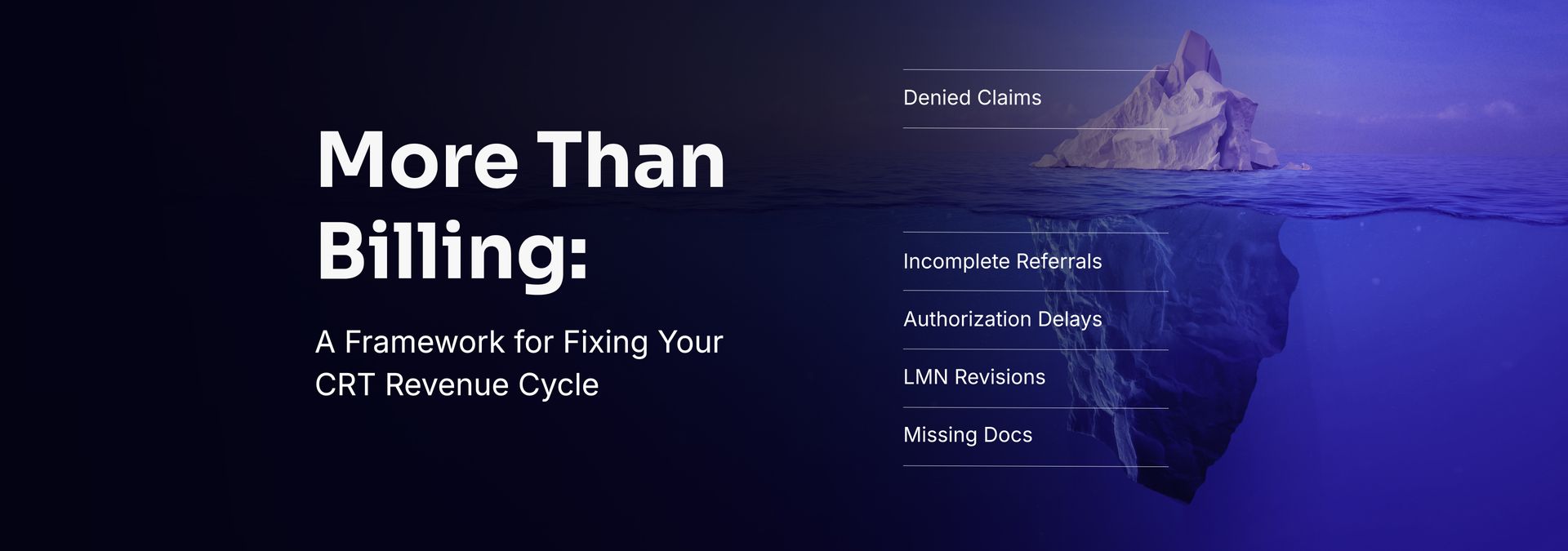
By the time a claim denies, the damage was usually done weeks earlier. The intake form was incomplete. The SOAP note was vague. The authorization expired. The HCPCS code didn’t match the documentation. The clinician noted the fitting but missed the medical necessity language. The billing team is just the person finding the broken pieces. They didn’t break them.
This matters because the fixes are completely different. You can’t fix intake gaps by hiring another biller. You can’t fix documentation gaps by buying a better clearinghouse. The leak has to be plugged where the water is actually getting in.
The leakage map: where dollars actually leave the revenue cycle
After working with hundreds of O&P and CRT practices, the leakage points cluster in seven specific places. Most practices are leaking from at least four of them, often without knowing it.
1. Incomplete intake
Revenue starts at intake. So does most denial risk. When demographic data is wrong, when insurance isn’t verified before delivery, when the patient’s authorization status is unclear, every downstream step is built on bad data. Fix this first or nothing else matters.
2. Missing or expired authorizations
Authorizations expire. They get denied. They never get requested in the first place because nobody owned the task. Each one represents a service delivered that may never be paid for. Top performers automate authorization tracking so nothing falls through.
3. Vague clinical documentation
The SOAP note that doesn’t establish medical necessity. The LMN that doesn’t match the HCPCS code submitted. The fitting note that omits the language a payer’s reviewer needs to see. Documentation is where audits are won or lost, and where many denials originate. AI-assisted documentation tools have changed this dramatically for practices that have adopted them.
4. Coding gaps
Codes that don’t reflect the work performed. Missed modifiers. Components that were delivered but not billed. Every gap is revenue that was earned and never claimed. A good claim-scrubbing process catches most of these before submission; without one, they show up as denials or, worse, as silent under-billing.
5. Slow time-to-bill
Every day between delivery and claim submission is a day of delayed cash flow and increased denial risk (since timely filing windows are unforgiving). Practices that measure in hours have a structural advantage over practices that measure in weeks. The gap is almost always a workflow gap, not an effort gap.
6. Denial follow-up that never happens
Denials come in every day. In many practices, follow-up happens when someone gets around to it, which is to say, partially. The 90-day appeal window passes. The denial becomes a write-off. The dollars are gone for good.
7. Write-offs nobody investigated
The most subtle leakage point. Write-offs happen, they get categorized, and they roll up into a monthly number that nobody examines. Investigating write-offs by payer surfaces patterns that drive contract conversations and process fixes. Most practices have never done it.
A real practice. Real numbers.
A mid-sized O&P practice we work with came to Nymbl with denial rates running at 12 percent, AR aging stretching cash flow thin, and a billing team that was demoralized from constantly chasing problems instead of preventing them.
After partnering with Nymbl on revenue cycle services, here’s what changed:
- Denial rates dropped to 4.5 percent. Below the high-performer benchmark, less than half of the industry average.
- AR aging decreased by 40 percent. Cash flow stabilized and the practice could plan further out.
- Staff productivity recovered. Billing time shifted from rework to forward-looking revenue cycle management.
They didn’t add billers. They didn’t change payers. They closed the leaks where they were actually happening: upstream from billing, in the intake and documentation workflows where the denials were being seeded weeks before the claims ever went out.
The honest read:
If your practice runs at 10–15 percent denials and you assume that’s "just the industry," you’re leaving a meaningful percentage of your revenue on the table every year. That number is not fixed. It’s a result of upstream processes you can change.
What good looks like
High-performing O&P and CRT revenue cycles have a few things in common. Intake is structured and complete before patients are scheduled. Documentation supports the codes being submitted. Authorizations are tracked automatically and never expire by surprise. Claim scrubbing happens before submission, not after denial. Denials get worked daily, not weekly. And write-offs get investigated by payer, because that’s where the contractual conversations live.
None of this requires more staff. All of it requires the right systems and the right cadence.
About the author.
John Bishop leads revenue cycle strategy at Nymbl, where he works with O&P, CRT, and HME practices to diagnose leakage, improve billing performance, and stand up the dashboards and KPIs that drive sustained growth.